Short sessions, on purpose
I bought an Xteink X4 Pro, an e-ink reader about the size of a phone, and wanted to build something genuinely useful for it. Before building anything, I spent a few days reading what owners say about these devices on Reddit, YouTube and GitHub.
What I heard
People use these readers to fill the gaps they used to scroll through: queues, commutes, walks with the dog, work breaks. One owner wrote that she'd read more in a month than in the three before it, simply because the reader was always in her pocket.
Long chapters stop people starting. The comment that stayed with me was from a reader who wouldn't begin a chapter if they could see they wouldn't finish it in the time they had. Nobody was solving that.
The sleep screen is the most loved part of the device. The liveliest threads were about what people put on it: football fixtures, calendars, wallpapers, even a small character that lives there.
Reading doesn't have to be productive. A comment saying exactly that drew over a hundred likes. Anything I built had to be free of streaks, counters and guilt.
These come from 11 Reddit threads, comments on 10 YouTube videos, and CrossPoint's GitHub issues and discussions, read in October 2026. They're what owners said, not a survey.
Why six minutes
The case is arithmetic. Adults read silently at about 260 words a minute for fiction and 238 for non-fiction (Brysbaert, 2019). Six minutes at 260 words a minute is about 1,560 words a day, or roughly 570,000 a year. That's five or six average-length novels from a habit small enough to keep on a bad day.
The number six came from somewhere less rigorous, and it's worth being honest about. A widely reported 2009 study by Mindlab International, commissioned by a chocolate brand, claimed six minutes of reading cut stress by 68%. It was commercial research and was never peer-reviewed, so I treat it as an inspiration rather than as evidence. Pocket Pages doesn't promise calm. It offers a short, finite thing to do instead of an endless one.
You can choose 4, 8 or 10 minutes in the converter if six doesn't suit.
Missing a day is fine
In a study following people forming new daily habits, missing a single day did not materially affect how the habit formed (Lally et al., 2010). So Pocket Pages has no streaks and no dates. That also suits the hardware: the X4 has no clock that survives sleep, so the next pocket moves on when you finish one, not when a day passes. Miss a week and the end card is still there, showing the same next pocket.
From sketch to screen
The end card started as a biro sketch, and the first version on the device spilled onto two pages. A dark image card came next, but it looked the same awake or asleep, so it never felt like the reader had switched off. What I wanted was a flip: a light card while you're reading, then white on black when the reader sleeps. That needed a small change to the reader's firmware.
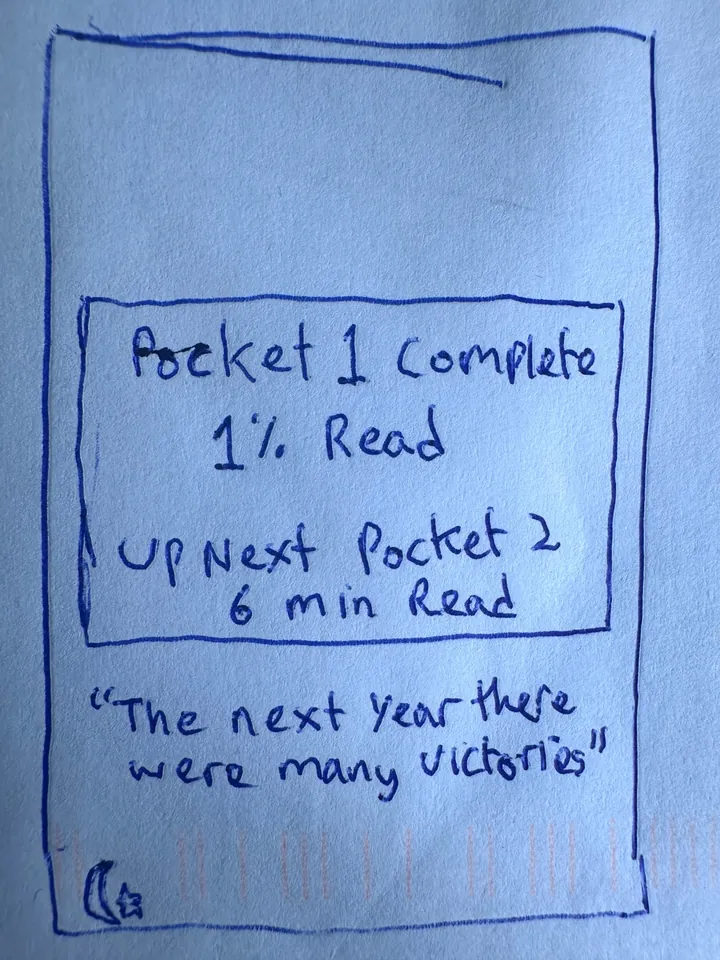
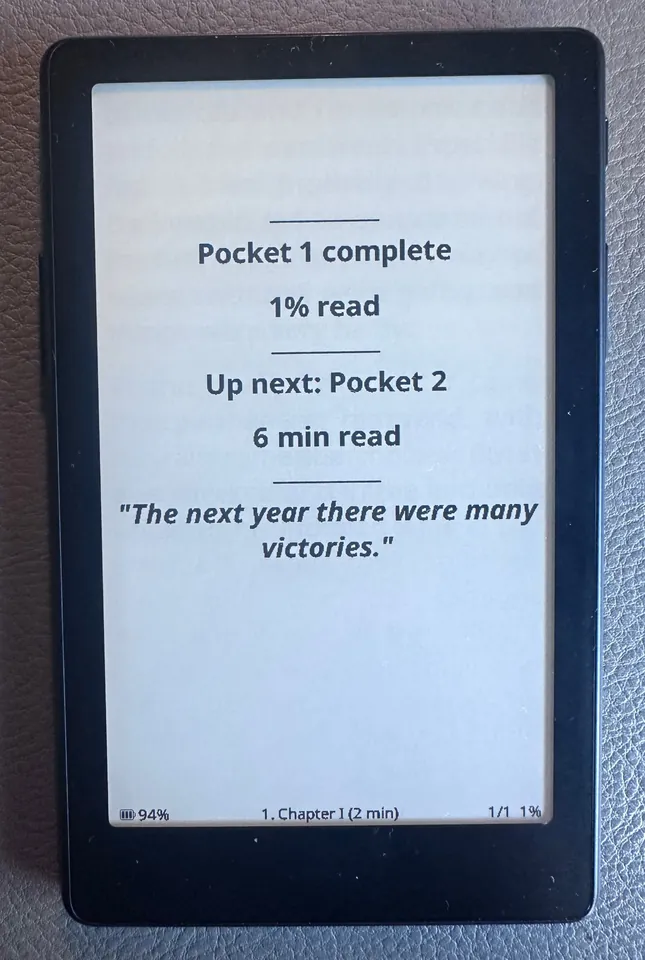
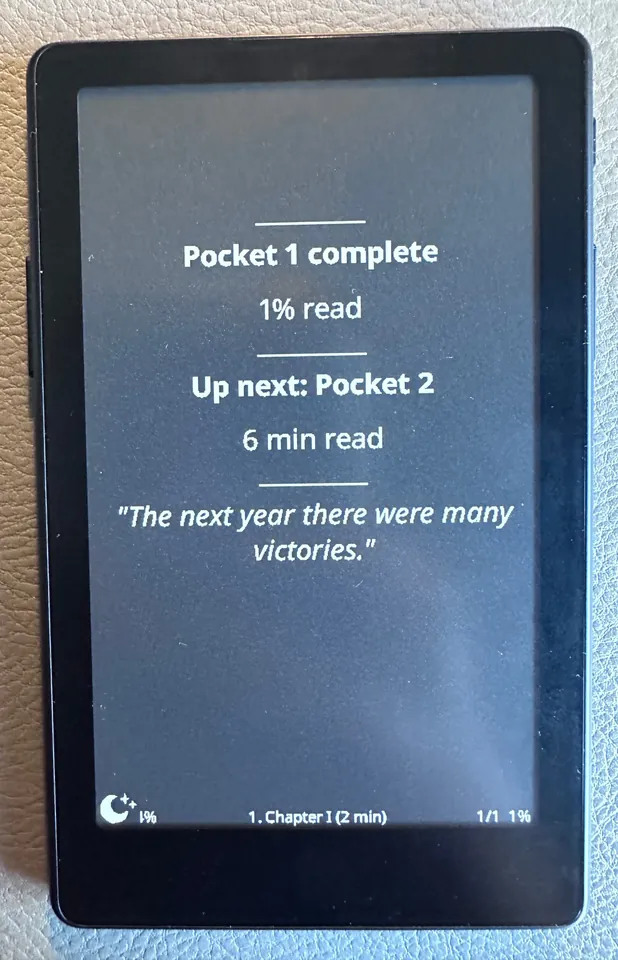
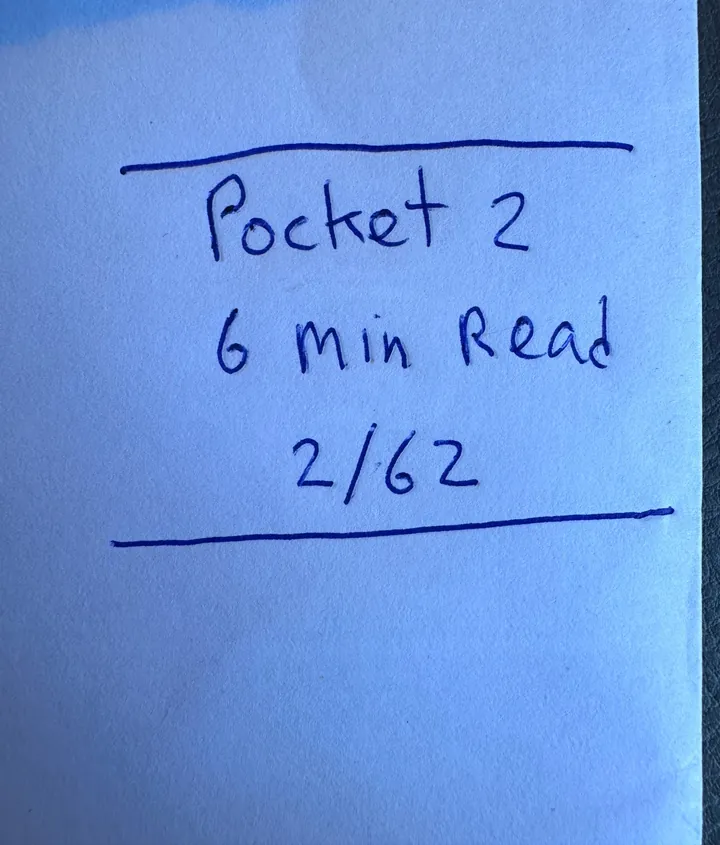
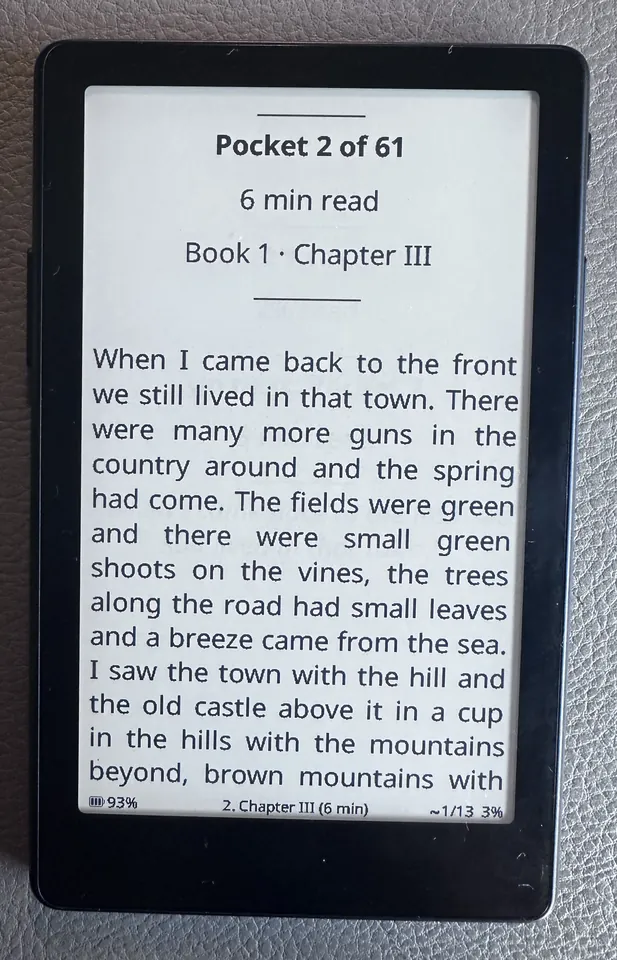
The card at the start of each pocket followed the same way. It first opened with a line quoting the end of the previous session, which turned out to be confusing out of context. It now mirrors the end card instead, so every session opens and closes in the same frame.
How it's built
The converter reads the book's own table of contents, falls back to chapter headings in the text when there isn't a useful one, and keeps front and back matter out of the pockets. It cuts at chapter ends first, then scene breaks, then paragraph ends, choosing every cut in a chapter together so pockets stay close to the length you asked for. Very short chapters are merged. Nothing is cut mid-paragraph.
It runs in your browser, so your books are never uploaded. The same logic also exists as a Python script. Both versions were run on nine test books, from tidy Standard Ebooks editions to messy Calibre-style and shop-style files, and cut every book at exactly the same places. Every paragraph of each source ends up in the output once, in order.
The firmware changes are two small additions toCrossPoint: a Quick Resume (Dark) sleep screen that inverts the page you stopped on, and a fix so headings can be regular weight when a book asks for it. Pocket Pages works without them; they make the end card look as intended.
Everything is open source on GitHub.
Sources
- Brysbaert, M. (2019) 'How many words do we read per minute? A review and meta-analysis of reading rate',Journal of Memory and Language, 109, 104047.doi:10.1016/j.jml.2019.104047
- Lally, P., van Jaarsveld, C.H.M., Potts, H.W.W. and Wardle, J. (2010) 'How are habits formed: Modelling habit formation in the real world', European Journal of Social Psychology, 40(6), pp. 998–1009.doi:10.1002/ejsp.674
- Mindlab International (2009) reading and stress study, commissioned by Galaxy chocolate and widely reported in the UK press. Not peer-reviewed; cited here as background, not evidence.
- Book texts: Standard Ebooks (public domain) andProject Gutenberg.